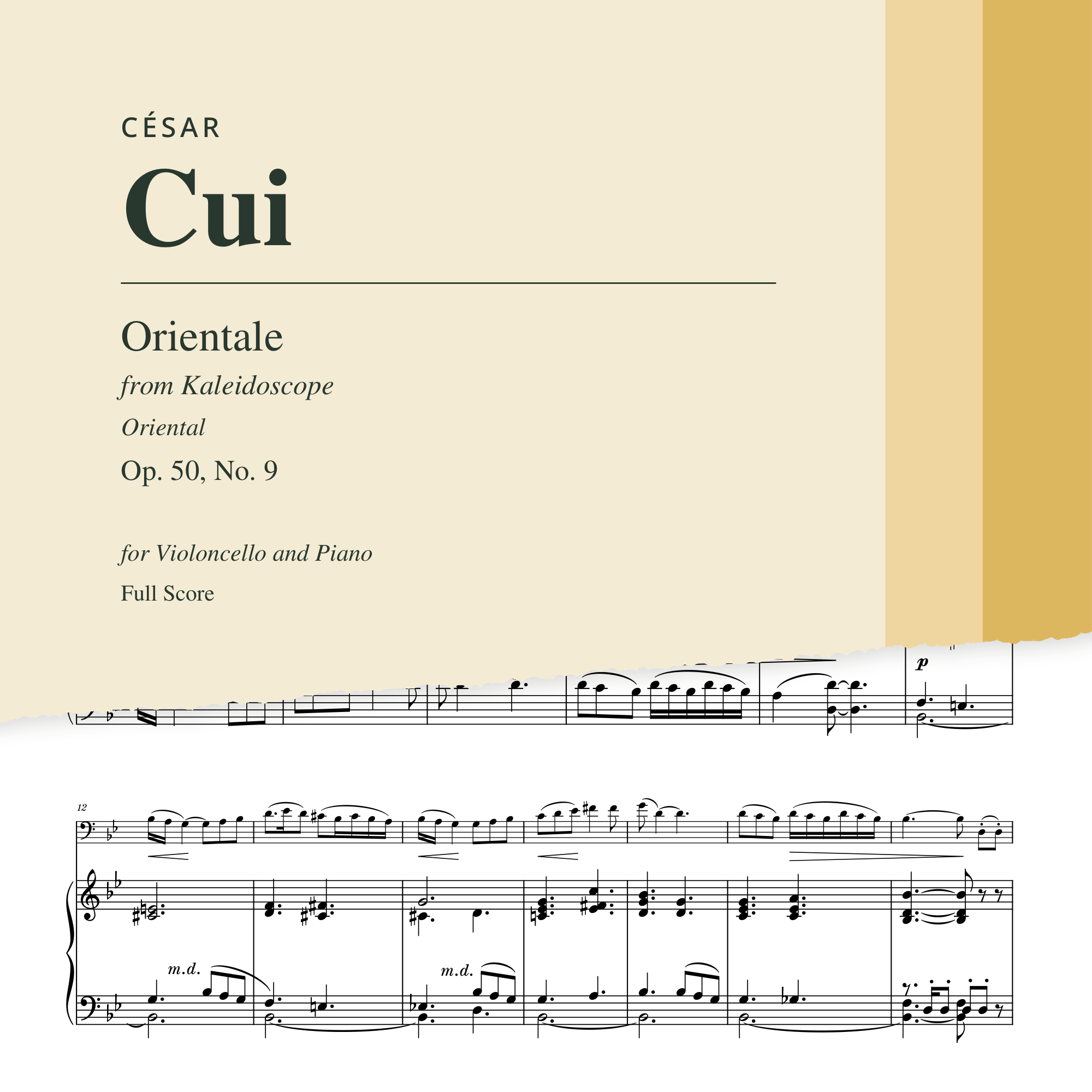
A newly engraved digital edition of César Cui’s Orientale, Op. 50, No. 9, from Kaleidoscope, available as a full score, separate violoncello part, or complete edition.
Available downloads
Full ScoreVioloncello and piano · Digital PDF
A$6
Violoncello PartSeparate performance part · Digital PDF
AMEB Cello Grade 4 · List CGeneral Knowledge study guide
Open the free score-based guide for the General Knowledge section.
Open guide +
Free study guide
AMEB Grade 4 General Knowledge
A score-based guide for the General Knowledge section of AMEB Cello Grade 4, using the cello part.
KeyG minor
Time signature
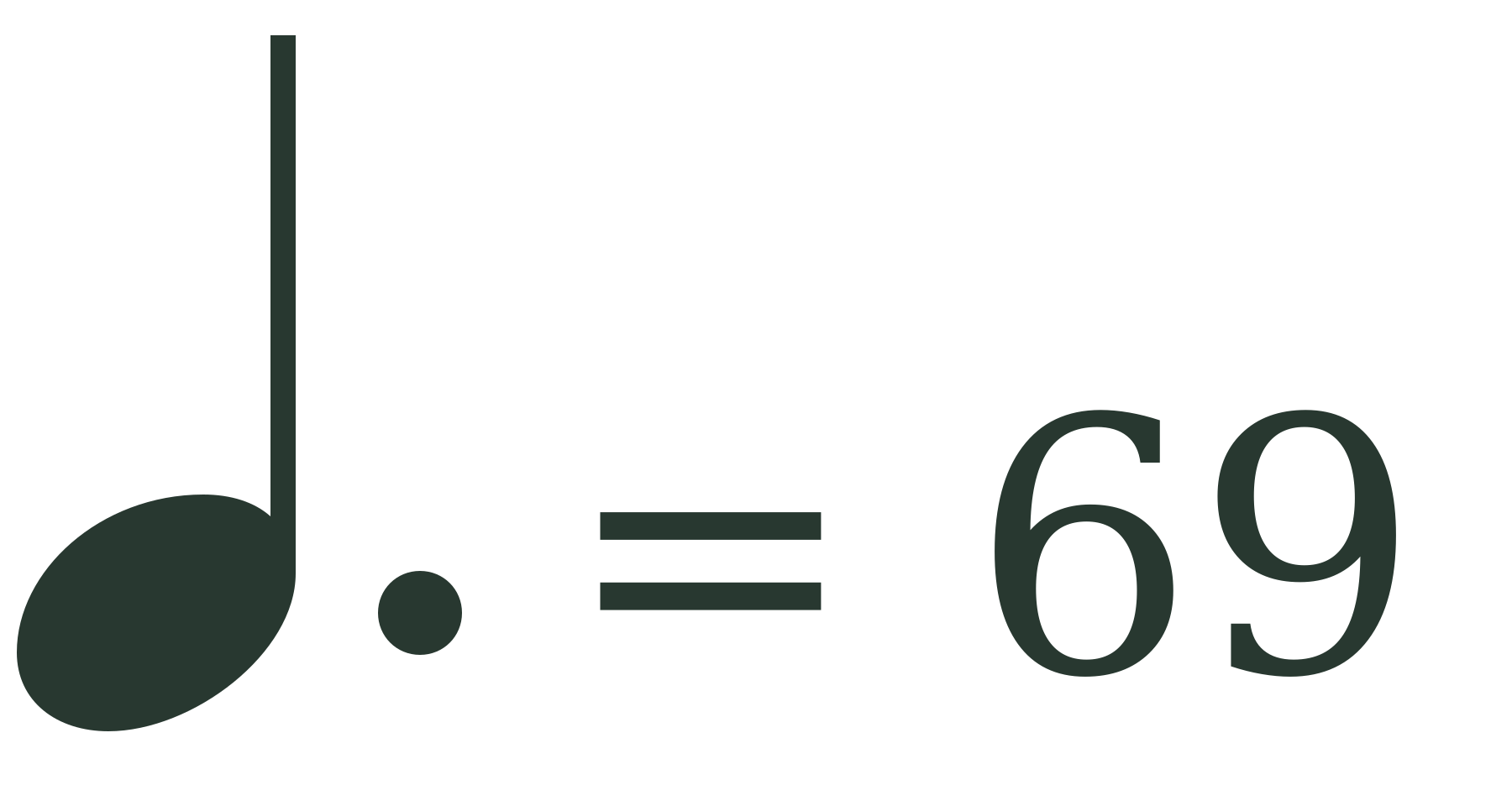
TempoAllegrettodotted crotchet = 69
TitleOrientale“Oriental” / “Eastern”
AMEBGrade 4 · List C
Notes and rests
Note values
Note values used in Orientale
Value
Relationship
Crotchet
Equal to two quavers.
Quaver
Half the value of a crotchet.
Semiquaver
Half the value of a quaver.
Dotted quaver
Equal to three semiquavers.
Rest values
Rest values used in Orientale
Value
Relationship
Dotted crotchet rest
Equal to three quaver rests.
Quaver rest
Silence for the value of one quaver.
Semiquaver rest
Silence for the value of one semiquaver.
6/8 time: two dotted-crotchet beats in a bar.
Signs, terms and symbols
Sort
Signs, terms and symbols used in the relevant score
Marking
Meaning
Where
Allegretto
Allegretto: moderately fast.
Beginning
Metronome mark: 69 dotted-crotchet beats per minute.
Beginning
riten.
Short for ritenuto: immediately slower; held back.
Bar 34
a tempo
A tempo: return to the previous tempo.
Bar 35
Pianississimo: extremely soft.
Final bar, 49
Mezzo forte: moderately loud.
First note, bar 1
con morbidezza
Piano, con morbidezza: softly, with softness or tenderness.
Bar 11
Crescendo: gradually become louder.
First appears in bar 12
Diminuendo: gradually become softer.
First appears in bar 17
Accent: give the note extra emphasis.
First note, bar 1
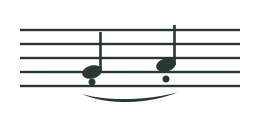
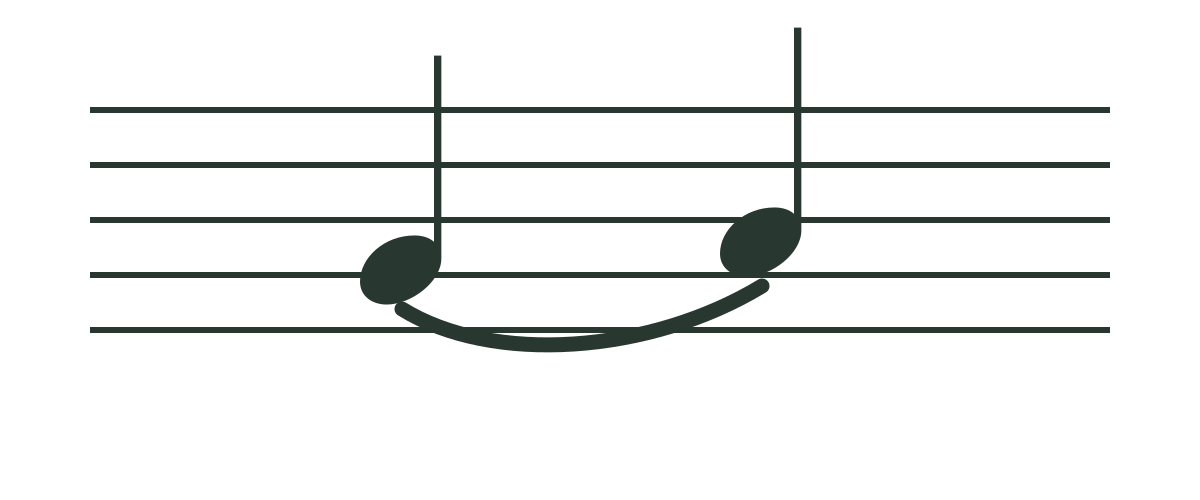
Staccato under a slur: staccato notes played in one bow.
First appears in bar 1
Slur: play the notes smoothly in one bow.
First appears in bar 1
pizz.
Short for pizzicato: pluck the string with a finger.
Bar 1, first beat
arco
Arco: use the bow.
Bar 1, after pizzicato
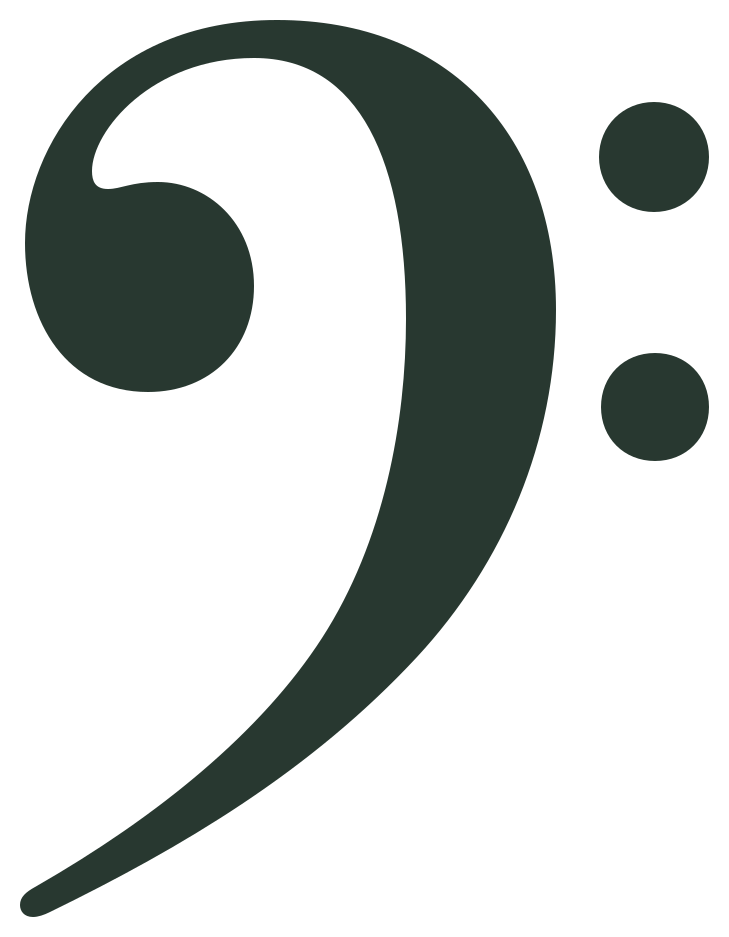
Bass clef (F clef).
Beginning; most of the piece
Treble clef (G clef).
Bars 36–37
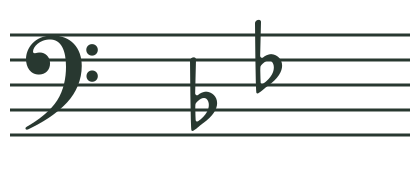
Flat: lowers a written note by one semitone.
Key signature, beginning
Natural: cancels a sharp or flat and returns the note to its natural pitch.
First appears in bar 9
Sharp: raises a written note by one semitone.
First appears in bar 10
6/8: two dotted-crotchet beats in a bar.
Beginning
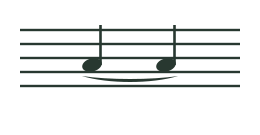
Tie: join two notes of the same pitch into one longer sound.
First appears in bar 12
Marks the end of the piece.
End of bar 49
In this cello part, staccato dots occur under slurs: the notes are staccato, but are played in one bow.
Key and tonality
Key: G minor.
Key signature: B♭ and E♭.
Key changes: there is no obvious, clear-cut modulation to another key.
Chromatic note: C♯ appears even though it is not part of the G minor key signature. In bar 11, C♯ to B♭ forms an augmented second — a tone and a half.
About the title
Orientale is French for “Eastern” or “Oriental”. The title does not point to one particular country; it refers to a stylised nineteenth-century idea of “Eastern” musical colour. In this piece, the recurring C♯–B♭ augmented second (a tone and a half) and the alternating pizzicato/arco figure help create that character.
Form
Ternary (ABA) with coda
Bars
Section
Key
1–18
A
G minor
19–26
B
G minor
27–42
A
G minor
43–49
Coda
G minor
Exam-style questions
What key is Orientale in?Show answer
G minor.
How many beats are in a bar of ?Show answer
Two dotted-crotchet beats in a bar.
What does Allegretto mean, and what does the metronome mark tell you?Show answer
Allegretto means moderately fast. Dotted crotchet = 69 means 69 dotted-crotchet beats per minute.
What is pizz. short for, and what do pizz. and arco mean?Show answer
Pizz. is short for pizzicato: pluck the string with a finger. Arco means use the bow.
What does p con morbidezza mean?Show answer
p means piano, softly; con morbidezza means with softness or tenderness.
What do the dots under the slur mean?Show answer
Staccato, played in one bow.
What do riten. and a tempo mean?Show answer
Riten. is short for ritenuto: immediately slower, or held back. A tempo means return to the previous tempo.
What is the clef at bar 36 called?Show answer
Treble clef.
Does the piece make an obvious, clear-cut change of key?Show answer
No. It remains centred on G minor.
What does the title Orientale mean, and what does it suggest about the music?Show answer
Orientale is French for “Eastern” or “Oriental”. It suggests a stylised “Eastern” musical character, heard here in features such as the recurring augmented second (a tone and a half) and the alternating pizzicato/arco figure.
This independent study guide is based on the cello part and is not published or endorsed by AMEB. Musical symbol artwork is based on Bravura, the SMuFL reference music font.